The Agon Console8 – two and a half years on
We spoke to Steve Sims, creator and main contributor of the Console8 GitHub organisation (now Agon Platform), about the changes to the Agon firmware since we released our Console8 two and a half years ago.
Updates to Agon – by Steve Sims
When Heber asked me to write an update on the changes to the Agon software since the launch of the Console8, I was excited to share what we had been working on. I quickly realised just how much had changed.
The best place to start is where my own Agon journey began.
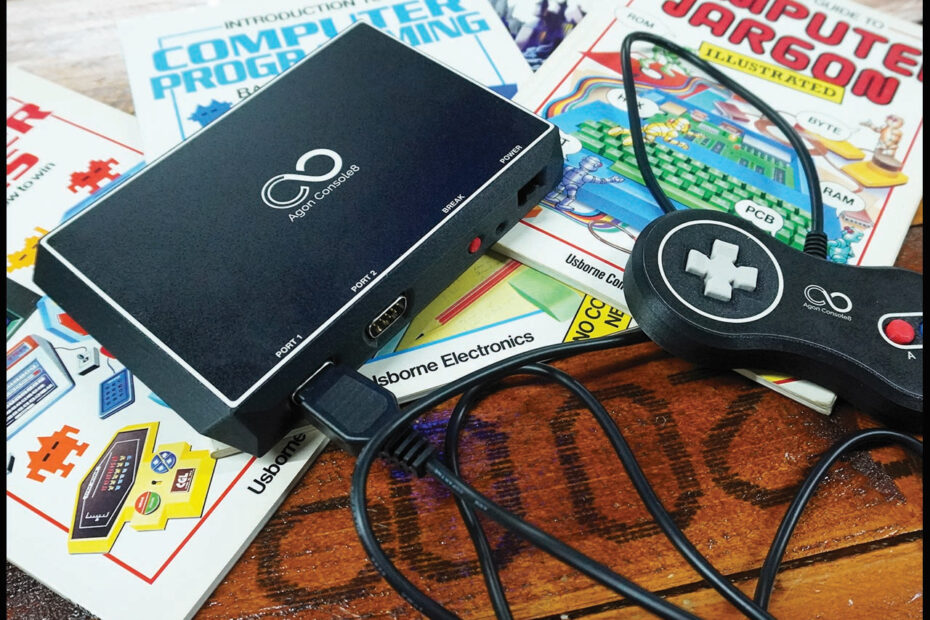
My involvement with Agon started several months before the Console8 launch, when Richard began dropping hints about a secret project. Eventually he revealed that it was a new version of the Agon Light, and I was fortunate enough to receive one of the first Agon Console8 prototype machines. It remains my main development machine to this day.
What first drew me properly into the firmware was audio. Richard and Holly from the Retro Collective were talking about the limitations of the original Agon sound system: three channels of triangle waves, which did indeed sound rather naff. They were toying with the idea of attaching a classic synthesis chip via GPIO to provide better sound. A typical hardware person solution… I was convinced the existing hardware ought to be capable of much more. It turned out the software used in the Agon’s VDP (Video Display Processor) was far more capable than the firmware exposed, so my first contribution was an enhanced audio API that unlocked that potential. The result was much better sound with no hardware changes.
And down the rabbit hole I went.
By the time the Agon Console8 launched, those audio improvements had been merged into the Agon Quark firmware, along with another major addition of mine: buffered commands.
To help get those ideas and improvements out more quickly, and to reduce the risk of Quark work being lost, I created the Agon Console8 GitHub organisation. Because the firmware releases were always compatible with all Agon models, the Console8 branding later caused some confusion, so about a year ago the organisation was renamed Agon Platform.
One early goal for the organisation was a community documentation site. That has been a real success, giving us a central place to share guides and reference material across the different Agon models while also making it easier for the community to contribute. The Agon Platform organisation has also become home to a number of other core tools from the Agon community.
My own work has remained focused mainly on firmware. At first it was mostly the VDP, but I have also spent a lot of time on MOS, the operating system that runs on the Agon’s main eZ80 CPU. For the MOS 2 releases my role was largely to take contributions from the community, add some enhancements of my own and help shepherd them through to release. For MOS 3.0, which came out about a year ago, I took a much more active role and introduced many ideas inspired by Acorn’s RISC OS. I still have plenty more in mind for MOS, though lack of free time has slowed progress recently.
Among the VDP changes, the biggest effort was filling in the gaps in support for Acorn’s VDU commands. The Agon’s VDP firmware is modelled on the VDU systems of the BBC Micro and Archimedes, so that gave us a clear target: improve compatibility while making better use of the underlying hardware. That work took time, but with VDP 2.16, released last week, we finally have full support for all Acorn plot commands. I have also added a number of extensions, taking inspiration from other 8- and 16-bit systems and going beyond the capabilities of the original underlying software.
Another long-desired improvement was proper hardware sprites. The original firmware supported “sprites”, but these were really more like automatically drawn bitmaps than a true hardware sprite system. In early 2025 Curtis, better known as “Turbovega”, worked out how to support full-colour hardware sprites on the Agon, and we collaborated to bring that into the VDP firmware. That work also led to a “Copper API”, inspired partly by the Commodore Amiga, allowing 2-, 4- and 16-colour screen modes to change palette on a per-scanline basis. That gives developers more colours on screen and opens the door to a range of visual effects.
There have been plenty of other VDP improvements too. One of the more powerful is the introduction of events and callbacks, which allow buffered command sequences on the VDP to react to changing conditions. This makes more complex interactions possible and helps us get more from the limited communications path between the main CPU and the VDP.
Envenomator has made Agon Platform the home for many of the tools he has developed. That includes improvements to utilities such as the flash tool and hexload. AgonDev deserves special mention as a desktop-computer based development environment for writing Agon programs in C, C++ and eZ80 assembler using modern tooling. He has also developed ez80asm, which runs both on desktop machines and on the Agon itself, as well as a web-based VDP firmware updating tool that has made updates much easier for users.
His most recent effort has been a new version of BBC BASIC V for the Agon that can take advantage of the eZ80 processor’s ADL mode. Richard T Russell created the original Z80 version of BBC BASIC 3 for Acorn’s Z80 second processor back in the 1980s, and Dean Belfield ported that to the Agon as part of Quark. Inspired by renewed interest in that code, RTR released an updated BBC BASIC V in late 2024, and Dean then produced a Z80-mode version for the Agon. Taking it properly into ADL mode is a substantial job. Envenomator recently took that on, building on Dean’s earlier work and on the significant progress Dean Netherton had already made towards an ADL version of RTR’s new BASIC V for the RC2014 computer. Progress has been rapid, with almost all features implemented and only a few bugs left to squash.
Tomm8086 is best known for fab-agon-emulator, which runs on desktop computers and gives developers an excellent way to build and test Agon software without needing the hardware itself. He has steadily improved the emulator, adding features and fixing bugs, and it has become an essential tool for many people in the community. He also curates “Popup MOS”, an SD card image containing a substantial collection of Agon software, which is a great starting point for users who want to explore the platform.
Sijnstra has also been a key part of the community, running the Agon & Console8 Community Discord server and creating a number of tools and libraries for the Agon. These include his Vezza adventure game engine, which continues to improve, along with utilities such as image loaders. More recently he added Agon support to the PASTA/80 Pascal compiler for desktop systems, which is a welcome addition for those who prefer to develop in Pascal.
Lennart Benschop has also made important contributions with his Agon FORTH implementation and his agon-utilities repository. Agon FORTH provides both 16-bit and ADL-capable 24-bit versions of the language, along with libraries, examples and games. Meanwhile, agon-utilities brings a growing collection of practical MOS tools and editors to the platform. Together they have broadened both the languages available on the Agon and the day-to-day tooling around it.
When Neil interviewed Richard and me at the Console8 launch, we were asked which piece of software we would most like to see running on the Agon. We both answered Elite. Christian Pinder, known for creating “Elite: The New Kind” for many different platforms, has since been working on an Agon port and has made excellent progress.
That progress has not always been fast, mostly because Christian keeps getting distracted by other worthwhile projects. One of those was an Agon version of Chuckie Egg which, after Elite, was my favourite game of the 8-bit era. His port is a faithful recreation of the BBC Micro original. He has also worked on an Agon version of MPAGD, the Multi-Platform Arcade Game Designer, and built a few games with it. Most recently his attention has turned to Deep C, a native C compiler and associated tooling that runs on the Agon itself. That is a significant development, because it means C programs can now be developed directly on the Agon rather than always being cross-compiled on a desktop PC.
I have undoubtedly left out plenty of other developments and contributors, and I apologise for that. Even as I write this I remember HeathenUK, who made important MOS enhancements and wrote a tracker music player. Still, I have to draw the line somewhere, and it is probably no bad thing to save a few highlights for the next update.
Links:
https://agonplatform.github.io/agon-docs/
https://github.com/AgonPlatform